Mostrando entradas con la etiqueta foreign languages. Mostrar todas las entradas

domingo, 9 de febrero de 2014

Practical English Usage: The book and the App.


Probably if you are reading this, you are already familiar with Practical English Usage as a book, and know how practical it is. There are many other interesting, well-known books, like Quirk and Greenbaum's A Student's grammar of the English Language which I used in college. There are plenty of books on grammar geared specifically either to students or to their teachers. 

Other grammar books include exercises. I have already spoken in one of my old posts about the classic English Grammar in Use which continues to be an excellent reference book for students and teachers, either in its original form or in its manifold reincarnations. 

But this one is just there to help you solve doubts. It is clear, easy to use and to the point. And now there is an app and for which I gladly paid a little over 20€. The opening screen looks definitely familiar.


The look and feel inside is equally practical and nifty. Since it is an app, the in-built instructions on how to navigate it are welcome:


The app offers you several "views" or approaches to the information. Watch out for the icon (flower? cabbage?) which appears on the front of the book and to the right of the word index in the following screenshot. (To the right of the word "index"):


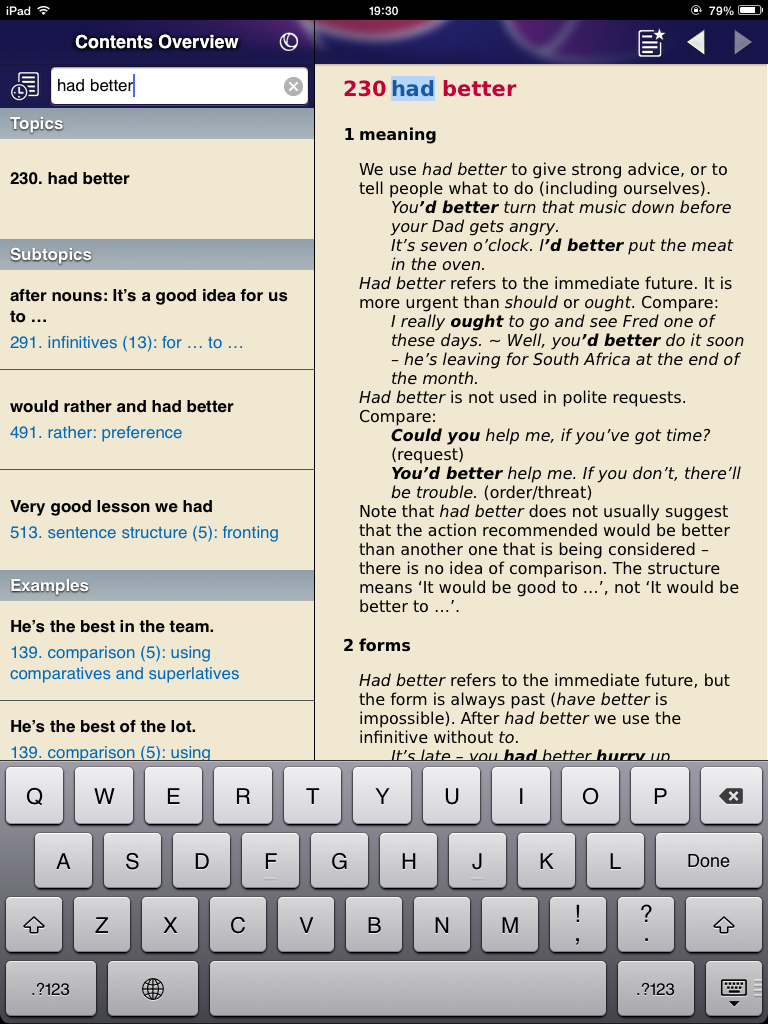
Here the same icon appears next to "contents overview",  but transformed, because it is a different view.


Yet another view, the topic index search. Again, the icon tells you which environment you are in.


Do you remember that grammar point you searched a while ago? The app remembers it for you.


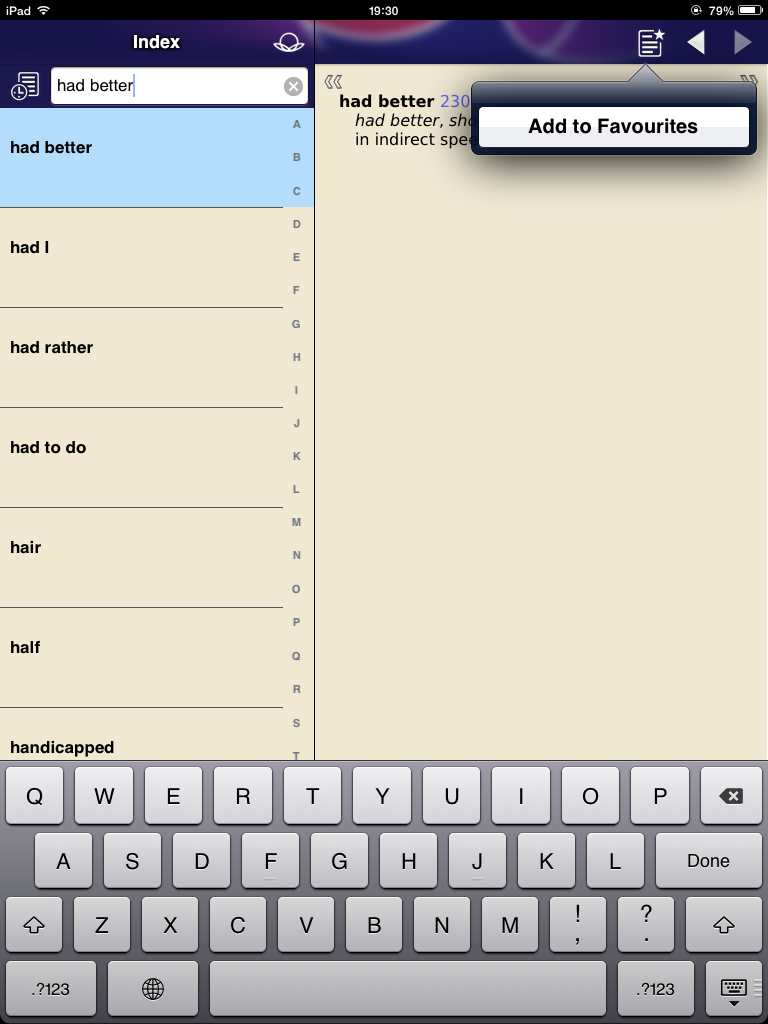
And if you want to keep tabs of the grammar points you like, you can create favourites. Remember your old book full of bookmarks and highlighted sections?


Although I wonder what this is doing in a grammar book, I think it is very welcome anyway in a reference book.


All in all, it is as complete as the book on which it is based, the interface is simple and practical and it allows to manage the information in useful ways. The creators seem to have had in mind what people use the book for, and so the result is really functional. Because I am a sentimental, sometimes I go back to my old paper version, but I can carry this around with me, even in my phone!

lunes, 3 de febrero de 2014

Why Finnish babies sleep in cardboard boxes (BBC NEWS article)

Here's my third in a series of articles that I find interesting for my students. This time, since one of them just had a baby, this might be appealing. But everyone can benefit from knowing more about babies, mothers and related stuff. Enjoy!

Thanks to the writer and the BBC for this wonderful article.

http://www.bbc.co.uk/news/magazine-22751415


For 75 years, Finland's expectant mothers have been given a box by the state. It's like a starter kit of clothes, sheets and toys that can even be used as a bed. And some say it helped Finland achieve one of the world's lowest infant mortality rates.
  1. Expectant mothers: women who are going to have a baby (so they are pregnant already!)
  2. starter kit: a collection of things given to someone who is going to start something: for example this.

It's a tradition that dates back to the 1930s and it's designed to give all children in Finland, no matter what background they're from, an equal start in life.
The maternity package - a gift from the government - is available to all expectant mothers.
It contains bodysuits, a sleeping bag, outdoor gear, bathing products for the baby, as well as nappies, bedding and a small mattress.
  1. To date back: to start or originate at a specific date.
  2. Outdoor gear: clothes and equipment used outside buildings.
  3. nappies: pieces of clothing or synthetic material used by babies to control pee and poo.
  4. Mattress: the thick surface on the bed where people sleep.  

With the mattress in the bottom, the box becomes a baby's first bed. Many children, from all social backgrounds, have their first naps within the safety of the box's four cardboard walls.
Mothers have a choice between taking the box, or a cash grant, currently set at 140 euros, but 95% opt for the box as it's worth much more.
The tradition dates back to 1938. To begin with, the scheme was only available to families on low incomes, but that changed in 1949.
  1. Cardboard: a material stronger than paper and weaker than wood.
  2. Cash grant: an quantity of money given to a person in order to pay for something. That money must be given back but without paying an interest or at a very low.
  3. Opt for: choose something.

"Not only was it offered to all mothers-to-be but the new legislation meant that in order to get the grant, or maternity box, they had to visit a doctor or municipal pre-natal clinic before their fourth month of pregnancy," says Heidi Liesivesi, who works at Kela - the Social Insurance Institution of Finland.
So the box provided mothers with what they needed to look after their baby, but it also helped steer pregnant women into the arms of the doctors and nurses of Finland's nascent welfare state.
In the 1930s Finland was a poor country and infant mortality was high - 65 out of 1,000 babies died. But the figures improved rapidly in the decades that followed.
  1. Mothers-to-be: pregnant women.
  2. to steer: to make something go in a specific direction: a car, a ship, a group of animals. (Steering wheel: what a driver uses to move the car right or left.
  3. nascent: something that started recently.

Mika Gissler, a professor at the National Institute for Health and Welfare in Helsinki, gives several reasons for this - the maternity box and pre-natal care for all women in the 1940s, followed in the 60s by a national health insurance system and the central hospital network.
At 75 years old, the box is now an established part of the Finnish rite of passage towards motherhood, uniting generations of women.
Reija Klemetti, a 49-year-old from Helsinki, remembers going to the post office to collect a box for one of her six children.


  1. Welfare: socially accepted conditions that are needed by everyone. Usually found in the expression "welfare state".
  2. Rite of passage: an event or activity that is considered necessary to start a new period in life, typically adulthood. (note: "-hood is a very frequent ending that signals an abstract noun, such as: neighbourhood, childhood, parenthood...")
"It was lovely and exciting to get it and somehow the first promise to the baby," she says. "My mum, friends and relatives were all eager to see what kind of things were inside and what colours they'd chosen for that year."
Her mother-in-law, aged 78, relied heavily on the box when she had the first of her four children in the 60s. At that point she had little idea what she would need, but it was all provided.
More recently, Klemetti's daughter Solja, aged 23, shared the sense of excitement that her mother had once experienced, when she took possession of the "first substantial thing" prior to the baby itself. She now has two young children.
"It's easy to know what year babies were born in, because the clothing in the box changes a little every year. It's nice to compare and think, 'Ah that kid was born in the same year as mine'," says Titta Vayrynen, a 35-year-old mother with two young boys.


  1. Eager: excited about a future event; looking forward to something.
  2. to rely (heavily) on something: to use something as help. If you rely heavily on something it means that you are using it a lot as help. For other meanings of rely on, please look here.
For some families, the contents of the box would be unaffordable if they were not free of charge, though for Vayrynen, it was more a question of saving time than money.
She was working long hours when pregnant with her first child, and was glad to be spared the effort of comparing prices and going out shopping.
"There was a recent report saying that Finnish mums are the happiest in the world, and the box was one thing that came to my mind. We are very well taken care of, even now when some public services have been cut down a little," she says.
When she had her second boy, Ilmari, Vayrynen opted for the cash grant instead of the box and just re-used the clothes worn by her first, Aarni.


  1. unaffordable: so expensive that you can't pay for it. (to afford: to be able to pay for something)
  2. free of charge: you don't have to pay anything.
  3. to be spared the effort: if you are spared the effort, you don't have to do something that would have been an effort for you. See spare.
  4. to take care of: to make sure that something or someone is in good condition, safe, healthy.


A boy can pass on clothes to a girl too, and vice versa, because the colours are deliberately gender-neutral.
The contents of the box have changed a good deal over the years, reflecting changing times.
During the 30s and 40s, it contained fabric because mothers were accustomed to making the baby's clothes.
But during World War II, flannel and plain-weave cotton were needed by the Defence Ministry, so some of the material was replaced by paper bed sheets and swaddling cloth.


  1. deliberately: something has been done with a specific intention.
  2. fabric: a clothing material elaborated in a specific manner: cotton, wool, polyester, spandex, flannel...
  3. flannel: a fabric used very commonly for things such as winter pyjamas or shirts. Very warm.
The 50s saw an increase in the number of ready-made clothes, and in the 60s and 70s these began to be made from new stretchy fabrics.
In 1968 a sleeping bag appeared, and the following year disposable nappies featured for the first time.
Not for long. At the turn of the century, the cloth nappies were back in and the disposable variety were out, having fallen out of favour on environmental grounds.
Encouraging good parenting has been part of the maternity box policy all along.
"Babies used to sleep in the same bed as their parents and it was recommended that they stop," says Panu Pulma, professor in Finnish and Nordic History at the University of Helsinki. "Including the box as a bed meant people started to let their babies sleep separately from them."


  1. ready-made clothes: clothes which you buy in the shop, instead of buying the fabric and making them at home. 
  2. stretchy fabrics: fabrics such as spandex (lycra) which are very useful for some baby clothes.
  3. sleeping bag: you sleep in one of these when you go camping.
  4. disposable nappies: one-use nappies which you buy at the supermarket.
  5. Cloth nappies: nappies made of cloth (usually cotton or linen) which are washed and re-used.
  6. fall-out of favour: something which people used to like, but not anymore.
  7. on environmental grounds: for reasons connected with the protection of the environment.
  8. to encourage: to motivate someone to do something, helping them, creating favourable conditions...
  9. Parenting: the activity of being a parent (being a father or a mother).
  10. all along: from the beginning to the end without relevant interruptions. See along.
At a certain point, baby bottles and dummies were removed to promote breastfeeding.
"One of the main goals of the whole system was to get women to breastfeed more," Pulma says. And, he adds, "It's happened."
He also thinks including a picture book has had a positive effect, encouraging children to handle books, and, one day, to read.
And in addition to all this, Pulma says, the box is a symbol. A symbol of the idea of equality, and of the importance of children.


  1. to remove: to take away from a place or situation.
  2. breastfeeding: giving a baby its mother's milk.
  3. picture book: usually a children's book, with very little or no text.
  4. to handle: to use and manipulate. Typical in boxes "handle with care".
Additional reporting by Mark Bosworth.

miércoles, 18 de septiembre de 2013

A relaxing cup of café con leche

Besides the obvious reaction to losing the 2020 Olympics and not even making it to the "silver medal", here in Spain and specially in Madrid, attention has been drawn to how far the choice was affected by the English proficiency of the city Mayor, Mrs Ana Botella.

I must admit I expected the president of the Autonomous community to have been equally embarrasing, but since nobody seemed to say anything bad about him, I doubled checked by looking at videos online showing the public television broadcast of the event and my impression is he spoke fluently and correctly.

Then there was the symptom of the voice-over. The video I found had a voice-over from the public television broadcast which made it very difficult to follow the "original soundtrack". And this got me thinking about the overall attitude of Spain as a country towards foreign languages - even to more than one national language.

If Mrs Ana Botella is our Frankenstein monster, it is a Frankenstein we all created. And there are millions like her.

First, a little bit of historical perspective. People would go and put all the blame on Franco, but again Franco is a product of centuries of evolution - or lack thereof - in Spanish mentality. In a nutshell, given our historical links, allegiances and conflicts, spaniards had reasons (valid or not) to distrust anything coming from the British Isles. Besides, we had the experience of being invaded by Napoleon's army and at that time the concept was fixed: don't trust them if they speak the language of the enemy. They must be the enemy. And if you want to be trusted don't learnt it.

This concept, which had been brewing for a long time, brought about the approach to foreign - and internal languages - other than Castilian Spanish, during Franco's dictatorship. A smugness extended itself, and a phrase was coined "let them learn Spanish. Anything but French, because it was admitted that French had class. It was the language of diplomacy...

And although the country was internationally isolated, you had to speak something other than Spanish, right? And French was sort of easy...

So, a whole cohort of Spanish people learnt some French at school. Most never used it and let it get rusty. In the meantime, the world changed and the US was the dominant power (other than the USSR which Franco abhorred: learning Russian was the worst thing you could do). Eventually Spain had to open itself up to tourism and this meant funny people who spoke an assortment of foreign languages.

But still the "let them learn Spanish" was the general attitude. Those who learnt some English or other languages, were generally happy to "get by", which is a very flexible concept. This concept has transformed nowadays in Spain into the equally elastic "intermediate English".

Certainly there was an landslide of american and foreign material on television in Spain which had started in cinemas before Franco's time. But there were tools to avoid that "contamination". In the first place, censorship often altered or even denied access to some materials. Then there was dubbing films, which is the usual practice to this day. This was vital in the malnourishment of multilingual skills in Spain.

An aside: there are four possible approaches to foreign content: dubbing, which assimilates the content completely to the country's culture and language; voice-over, which reduces the original soundtrack to background noise; subtitling, which is a somewhat cumbersome compromise between bilinguals who want to hear the original and those who can't speak the language and finally just watching/listening in the original version.

(Also, you can watch things with subtitles in the original language and learn a lot!)

In Spain dubbing was promoted to the extent that it became an industry and its specialists made it into an art. There are many excellent dubbing jobs both in film and television in Spain, just to name one "The fresh prince of Bel Air". The downside of this was that people continued to avoid what has become now an urgent need: becoming bilingual. Will Smith spoke such good Spanish!

As a language consultant I have to deal with the results of this wreckage every day. Not until the crisis struck did companies - and their employees at an individual level - realize how urgent their need was. The spanish market evaporated overnight, LatAm is limited. They look for other markets. Oh surprise, suddenly I need more than just the "get by" attitude. No English, no business.

And in this sort of "they don't know what hit them" eerie state, we can include Ana Botella. With all this background she can't be blamed completely for her non-existent English. However, it wouldn't have hurt if she had gone to class hand in hand with her husband, once he became ex-Prime Minister.

He was the laughing stock when his efforts to learn English and put it to use were publicly known. As a professional in the field I must praise his guts. His starting point was the same as his wife's but he decided to solve the problem. And that's a decision that many people and many companies still have to take in Spain.

Back to the Ana Botella controversy, her advisor, Mr Terrence Burns, is an expert advisor and consultant and has succesfully helped several other cities in becoming Olympic. I don't know much about what was going on in the background, but from the outside it seems that Mr Burns has never seen himself in such dire straits.

Let me explain. Mr Burns had to do many things, including coaching Ana Botella for the promotion of Madrid 2020. An obvious bonus would be, someone thought, if she defended it with a speech in English. What a great idea! As a marketing strategy it is a logical move.

Not really. Because it backfired.

People who learn things phonetically are typically people with a musical training which I expect Ana Botella does not have. A famous case in this sense was Pavarotti. He had that skills, to the point that he couldn't read music scores but could sing incredibly well in languages he did not speak.

One thing which I do with my clients is explain them where the problems lay and how things work. Obviously in order to do that, you need an insight into the topic. That's where, in my opinion, the training of Mrs Botella should have been handed to a language expert. I have no doubt about other skills that Mr. Burns may possess, but the language hurdle was one which he was not ready to address.

Yet another aside: my opinion is that Mrs. Botella's english proficiency did not play a significant role in not getting the olympics for Madrid. It was just a very public and very notorious embarrasment.

Alternatives to what happened in Buenos Aires: she could have spoken in Spanish (after all it is not a tiny, irrelevant language that a bunch of people speak on a small island somewhere) or even better, she could have introduced briefly someone who could do it better, like some spanish athlete or maybe the councillor for sports (if there is one and if he can speak English).

It is a national sport to laugh at people in disgrace. Mrs Botella made it crystal clear that she completely lacked a skill that is vital if you are the mayor of a world-class capital that aspires to hosting the olympics. But she is the tip of the iceberg. The employees and executives of many companies in Spain are in similar situations and their business opportunities are seriously compromised by their deficiencies or their lack of english skills. Many unemployed people in this country would have a job abroad if only they spoke decently other languages besides Spanish.

Solutions to this? that is a topic for a different post. This is long enough!