Mostrando entradas con la etiqueta learning English. Mostrar todas las entradas

domingo, 9 de febrero de 2014

Practical English Usage: The book and the App.


Probably if you are reading this, you are already familiar with Practical English Usage as a book, and know how practical it is. There are many other interesting, well-known books, like Quirk and Greenbaum's A Student's grammar of the English Language which I used in college. There are plenty of books on grammar geared specifically either to students or to their teachers. 

Other grammar books include exercises. I have already spoken in one of my old posts about the classic English Grammar in Use which continues to be an excellent reference book for students and teachers, either in its original form or in its manifold reincarnations. 

But this one is just there to help you solve doubts. It is clear, easy to use and to the point. And now there is an app and for which I gladly paid a little over 20€. The opening screen looks definitely familiar.


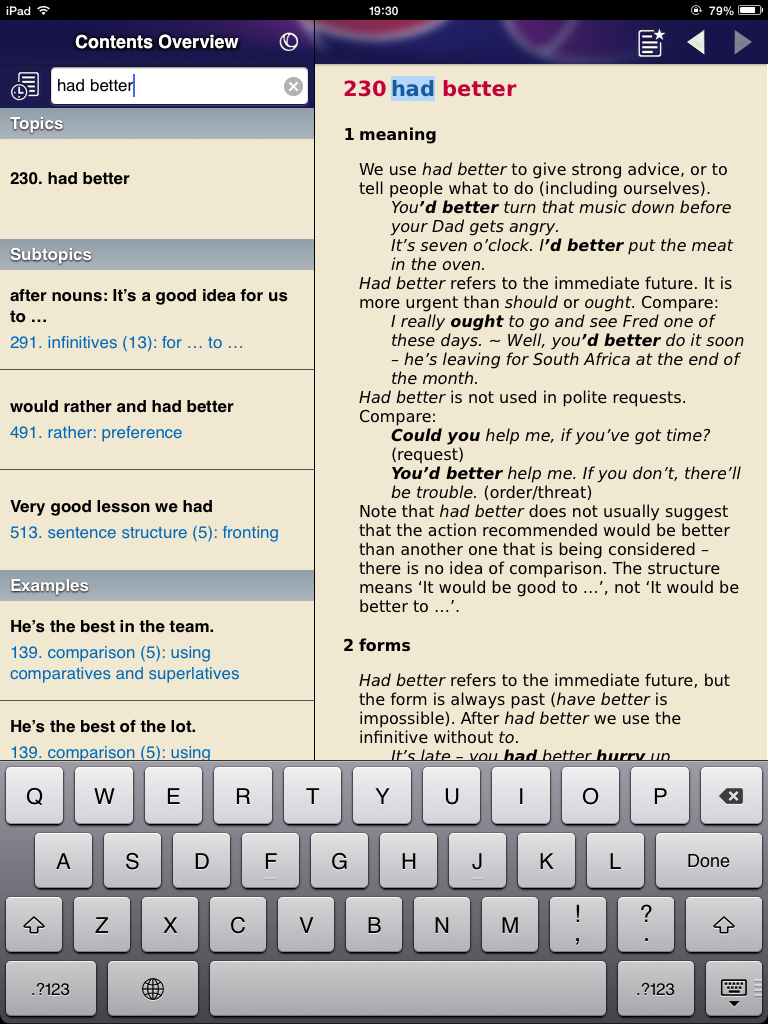
The look and feel inside is equally practical and nifty. Since it is an app, the in-built instructions on how to navigate it are welcome:


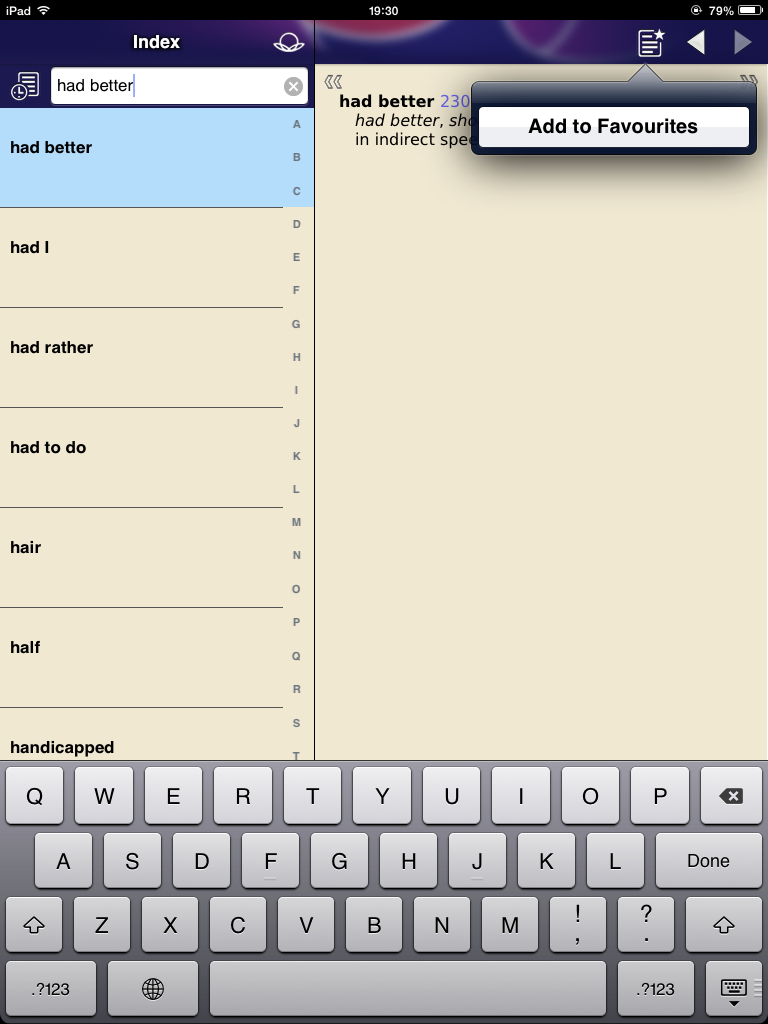
The app offers you several "views" or approaches to the information. Watch out for the icon (flower? cabbage?) which appears on the front of the book and to the right of the word index in the following screenshot. (To the right of the word "index"):


Here the same icon appears next to "contents overview",  but transformed, because it is a different view.


Yet another view, the topic index search. Again, the icon tells you which environment you are in.


Do you remember that grammar point you searched a while ago? The app remembers it for you.


And if you want to keep tabs of the grammar points you like, you can create favourites. Remember your old book full of bookmarks and highlighted sections?


Although I wonder what this is doing in a grammar book, I think it is very welcome anyway in a reference book.


All in all, it is as complete as the book on which it is based, the interface is simple and practical and it allows to manage the information in useful ways. The creators seem to have had in mind what people use the book for, and so the result is really functional. Because I am a sentimental, sometimes I go back to my old paper version, but I can carry this around with me, even in my phone!

lunes, 3 de febrero de 2014

Why Finnish babies sleep in cardboard boxes (BBC NEWS article)

Here's my third in a series of articles that I find interesting for my students. This time, since one of them just had a baby, this might be appealing. But everyone can benefit from knowing more about babies, mothers and related stuff. Enjoy!

Thanks to the writer and the BBC for this wonderful article.

http://www.bbc.co.uk/news/magazine-22751415


For 75 years, Finland's expectant mothers have been given a box by the state. It's like a starter kit of clothes, sheets and toys that can even be used as a bed. And some say it helped Finland achieve one of the world's lowest infant mortality rates.
  1. Expectant mothers: women who are going to have a baby (so they are pregnant already!)
  2. starter kit: a collection of things given to someone who is going to start something: for example this.

It's a tradition that dates back to the 1930s and it's designed to give all children in Finland, no matter what background they're from, an equal start in life.
The maternity package - a gift from the government - is available to all expectant mothers.
It contains bodysuits, a sleeping bag, outdoor gear, bathing products for the baby, as well as nappies, bedding and a small mattress.
  1. To date back: to start or originate at a specific date.
  2. Outdoor gear: clothes and equipment used outside buildings.
  3. nappies: pieces of clothing or synthetic material used by babies to control pee and poo.
  4. Mattress: the thick surface on the bed where people sleep.  

With the mattress in the bottom, the box becomes a baby's first bed. Many children, from all social backgrounds, have their first naps within the safety of the box's four cardboard walls.
Mothers have a choice between taking the box, or a cash grant, currently set at 140 euros, but 95% opt for the box as it's worth much more.
The tradition dates back to 1938. To begin with, the scheme was only available to families on low incomes, but that changed in 1949.
  1. Cardboard: a material stronger than paper and weaker than wood.
  2. Cash grant: an quantity of money given to a person in order to pay for something. That money must be given back but without paying an interest or at a very low.
  3. Opt for: choose something.

"Not only was it offered to all mothers-to-be but the new legislation meant that in order to get the grant, or maternity box, they had to visit a doctor or municipal pre-natal clinic before their fourth month of pregnancy," says Heidi Liesivesi, who works at Kela - the Social Insurance Institution of Finland.
So the box provided mothers with what they needed to look after their baby, but it also helped steer pregnant women into the arms of the doctors and nurses of Finland's nascent welfare state.
In the 1930s Finland was a poor country and infant mortality was high - 65 out of 1,000 babies died. But the figures improved rapidly in the decades that followed.
  1. Mothers-to-be: pregnant women.
  2. to steer: to make something go in a specific direction: a car, a ship, a group of animals. (Steering wheel: what a driver uses to move the car right or left.
  3. nascent: something that started recently.

Mika Gissler, a professor at the National Institute for Health and Welfare in Helsinki, gives several reasons for this - the maternity box and pre-natal care for all women in the 1940s, followed in the 60s by a national health insurance system and the central hospital network.
At 75 years old, the box is now an established part of the Finnish rite of passage towards motherhood, uniting generations of women.
Reija Klemetti, a 49-year-old from Helsinki, remembers going to the post office to collect a box for one of her six children.


  1. Welfare: socially accepted conditions that are needed by everyone. Usually found in the expression "welfare state".
  2. Rite of passage: an event or activity that is considered necessary to start a new period in life, typically adulthood. (note: "-hood is a very frequent ending that signals an abstract noun, such as: neighbourhood, childhood, parenthood...")
"It was lovely and exciting to get it and somehow the first promise to the baby," she says. "My mum, friends and relatives were all eager to see what kind of things were inside and what colours they'd chosen for that year."
Her mother-in-law, aged 78, relied heavily on the box when she had the first of her four children in the 60s. At that point she had little idea what she would need, but it was all provided.
More recently, Klemetti's daughter Solja, aged 23, shared the sense of excitement that her mother had once experienced, when she took possession of the "first substantial thing" prior to the baby itself. She now has two young children.
"It's easy to know what year babies were born in, because the clothing in the box changes a little every year. It's nice to compare and think, 'Ah that kid was born in the same year as mine'," says Titta Vayrynen, a 35-year-old mother with two young boys.


  1. Eager: excited about a future event; looking forward to something.
  2. to rely (heavily) on something: to use something as help. If you rely heavily on something it means that you are using it a lot as help. For other meanings of rely on, please look here.
For some families, the contents of the box would be unaffordable if they were not free of charge, though for Vayrynen, it was more a question of saving time than money.
She was working long hours when pregnant with her first child, and was glad to be spared the effort of comparing prices and going out shopping.
"There was a recent report saying that Finnish mums are the happiest in the world, and the box was one thing that came to my mind. We are very well taken care of, even now when some public services have been cut down a little," she says.
When she had her second boy, Ilmari, Vayrynen opted for the cash grant instead of the box and just re-used the clothes worn by her first, Aarni.


  1. unaffordable: so expensive that you can't pay for it. (to afford: to be able to pay for something)
  2. free of charge: you don't have to pay anything.
  3. to be spared the effort: if you are spared the effort, you don't have to do something that would have been an effort for you. See spare.
  4. to take care of: to make sure that something or someone is in good condition, safe, healthy.


A boy can pass on clothes to a girl too, and vice versa, because the colours are deliberately gender-neutral.
The contents of the box have changed a good deal over the years, reflecting changing times.
During the 30s and 40s, it contained fabric because mothers were accustomed to making the baby's clothes.
But during World War II, flannel and plain-weave cotton were needed by the Defence Ministry, so some of the material was replaced by paper bed sheets and swaddling cloth.


  1. deliberately: something has been done with a specific intention.
  2. fabric: a clothing material elaborated in a specific manner: cotton, wool, polyester, spandex, flannel...
  3. flannel: a fabric used very commonly for things such as winter pyjamas or shirts. Very warm.
The 50s saw an increase in the number of ready-made clothes, and in the 60s and 70s these began to be made from new stretchy fabrics.
In 1968 a sleeping bag appeared, and the following year disposable nappies featured for the first time.
Not for long. At the turn of the century, the cloth nappies were back in and the disposable variety were out, having fallen out of favour on environmental grounds.
Encouraging good parenting has been part of the maternity box policy all along.
"Babies used to sleep in the same bed as their parents and it was recommended that they stop," says Panu Pulma, professor in Finnish and Nordic History at the University of Helsinki. "Including the box as a bed meant people started to let their babies sleep separately from them."


  1. ready-made clothes: clothes which you buy in the shop, instead of buying the fabric and making them at home. 
  2. stretchy fabrics: fabrics such as spandex (lycra) which are very useful for some baby clothes.
  3. sleeping bag: you sleep in one of these when you go camping.
  4. disposable nappies: one-use nappies which you buy at the supermarket.
  5. Cloth nappies: nappies made of cloth (usually cotton or linen) which are washed and re-used.
  6. fall-out of favour: something which people used to like, but not anymore.
  7. on environmental grounds: for reasons connected with the protection of the environment.
  8. to encourage: to motivate someone to do something, helping them, creating favourable conditions...
  9. Parenting: the activity of being a parent (being a father or a mother).
  10. all along: from the beginning to the end without relevant interruptions. See along.
At a certain point, baby bottles and dummies were removed to promote breastfeeding.
"One of the main goals of the whole system was to get women to breastfeed more," Pulma says. And, he adds, "It's happened."
He also thinks including a picture book has had a positive effect, encouraging children to handle books, and, one day, to read.
And in addition to all this, Pulma says, the box is a symbol. A symbol of the idea of equality, and of the importance of children.


  1. to remove: to take away from a place or situation.
  2. breastfeeding: giving a baby its mother's milk.
  3. picture book: usually a children's book, with very little or no text.
  4. to handle: to use and manipulate. Typical in boxes "handle with care".
Additional reporting by Mark Bosworth.

viernes, 31 de enero de 2014

If you want to recycle buy a chicken... but don't eat it!

After my post on parks in the UK, I remembered from some years ago about this piece of news. First of all here is the original link, as a thank you for the journalist who wrote the article!

http://www.independent.co.uk/news/world/europe/belgians-egged-on-to-keep-chickens-ndash--but-theyre-not-for-eating-1942124.html

Now let's go to the article. There are lots and lots of interesting things to comment on and learn about.

Belgians egged on to keep chickens – but they're not for eating

Hen-rearing craze takes hold after drive to reduce household waste
In a garden dotted with daffodils overlooking open fields, a trio of English Sussex hens strut their stuff. Two small boys stroke their resplendent white and black plumage while feeding them. The youngest child takes advantage of the diversion to dive into the birds' dark-red wooden coop to play hide-and-seek.


  1. to dot: distribution of elements at regular intervals. To see an example, click here and look at the picture on the right.
  2. to overlook: in this case, to look at something from a higher point. Other very common meaning means "not to notice something, voluntarily or by accident."
  3. to strut: to walk like a bird does, e.g. a chicken.
  4. plumage: same as in Spanish, but with "g" instead of "j".
  5. To dive: usually to jump into the water or swim under it. Used as a metaphor here.
  6. hide-and-seek: traditional children's game where one of the children has to count and the others find a place to hide. Once the count is finished, the first child tries to find the rest.

  • note: difference between notice and news: notice is a piece of written information in a visible location or sent to you by post. News (uncountable) is information provided by journalists, in newspapers, on the TV... to speak about it individually you have to say "a piece of news" (=una noticia).
"We get two eggs every day, which go towards making pancakes," says Tibo Duijsters, a blond eight-year old, as he scatters grain around the ground.
Their father Michel Duijsters points proudly to his fast-disappearing compost heap. Most of the food scraps and vegetable peelings have been eaten by the hens.
The Duijsters and many of their neighbours in Dilsem-Stokkem, a small town of neat detached houses a few miles from Belgium's border with the Netherlands, have no agricultural background or training in poultry farming. But they have joined a chicken-rearing craze which has taken hold with tens of thousands of hens now living in coops in family gardens.
The boom is thanks to own-a-chicken schemes launched by the Belgian authorities in a bid to cut down on household waste. In the region of Limburg, near the Dutch border, more than 2,500 families adopted hens just last year, a 306 per cent rise on the previous year. There have been similar successes in other parts of the country.


  1. to go towards: go in a specific direction. in this case, the eggs' direction is being eaten as pancakes.
  2. to scatter: to spread over a big space elements that were together before. e.g. the plate fell from the table and the food was scattered all over the floor.
  3. proudly: feeling proud. someone is proud of something or someone when they are happy about being connected with it (for example your children).
  4. heap: a disorganized accumulation of something e.g. garbage bags on the street when there is no container!
  5. scraps: in this case, remains from food that has been eaten. also vegetable and fruit peels, etc.
  6. neat: nice, clean, organized.
  7. detached: a detached house is a house which is separated from others around it. If it shares a wall with another house it is called "semidetached" and if they are part of a row of houses they are called "terraced houses".
  8. background: work experience (in this context)
  9. poultry: this word refers to any farm birds (so, domestic birds which aren't pets)
  10. craze: collective craziness or intense fashion.
  11. coop: the house where the hen lives. 
  12. scheme: a system or organization.
  13. bid: to place your money because you think something will happen and you will benefit from it.
  14. cut down: reduce.
  15. rise: to go up. note: raise means to "make something go up". e.g. I raised the curtain with my hand. Compare: The sun rises every morning.
  16. success (plural: successes). obtaining the result that you wanted. Note: Success can also work as uncountable.


The Duijsters family were egged on by a marketing campaign by the authorities, which also subsidises the cost of buying the hens. One hen only costs around €4 (£3.50), but comes with expectations.
"We expect owners to look after them properly and provide a lot of reading material for them to go through," said Annick De Paepe, an official with the Limburg regional authority.


  1. to subsidise: to pay with public funds, partly or completely something that private citizens or companies need to pay for.
  2. properly: in the right way. If something is proper it is correct and adequate. Like Mr. Proper!


"It's been a huge success and it's proving ever more popular". She believes the boom has been fuelled by the recession. "There is very much a mood of getting back to nature right now and people love picking up their own eggs from the garden. But it's also a great way to cut down on household waste as the chickens will eat any leftovers and cut organic waste by half."


  1. ever more popular: more and more popular, people like it more and more.
  2. to fuel: to give something energy or impulse. Fuel: gasoline, kerosene, diesel oil...
  3. mood: if you are happy you are in a good mood, if you are sad or depressed you are in a bad mood. If you change from one mood to another you are a moody person.
  4. to pick up: to get something that is lower than you. For example on the floor.
  5. to cut down on something: to reduce (usually expenses) on some specific area.
  6. leftovers: usually it applies to food that still remains after people have finished eating.


"So far, we haven't had any bad experiences, but of course, we can't be sure that people aren't just throwing them into the oven. Not everyone wants to take on a chicken for life."
Mr Duijsters, a civil servant, leads the twice-daily feeding round and says the hens have become part of the family. "They look so lovely and they do all have their own personalities. They get very impatient if they don't get fed on time and come pecking at the windows to complain.
"But it's nothing unusual around here. Everyone seems to own hens, it's the thing to do"
In the Flemish regions of Belgium, authorities typically apply a stringent approach to ensuring the well-being of the chickens.

  1. to take on: to adopt something or someone (except if it's a new son or daughter then it is adopt.
  2. to lead: to make someone go in a specific direction, physical or metaphorical.
  3. to peck: the way birds eat on the ground.
  4. stringent: something that limits
  5. ensuring. To ensure: to make sure that something is in a specific way. In this example, they want to know for sure that the chickens are alive and happy!


"We have proper training courses in rearing and feeding the hens and we watch out for anyone who might not be suitable," said Christophe Deneve, who recently launched a chicken scheme in Mouscron.
The town, a stone's throw from the Belgian-French border, is distributing 50 pairs of chickens for free to families with sufficient space to keep the birds in their gardens.
But anyone who takes part has to agree not to eat the chickens for at least two years, or give them away.

  1. suitable: appropriate, right for a person, thing or situation.
  2. to launch: to start. literally to send something into the air or space.
  3. a stone's throw from: talking about distances, a very short distance (as far as you can throw a stone). The same expression exists in Spanish.

I hope you enjoyed this story about a very clever way to recycle the food. Your opinions and ideas are welcome in the comments section!

sábado, 28 de septiembre de 2013

Alternative sources of learning or where to look at when the ordinary way is not the answer...

From time to time a thought keeps popping up... how would I have learnt and expanded my English, had I had the resources that I have now. When I was in College, my resources were basically books, the hardcopy variety. I spent more money than I could afford on them. And where my money and bookstores would not help me I completed my diet with books which I borrowed from the library, which I wolfed down either on the spot or home.

Back to the present, one of the things that anger me - yes, outright anger - is how, having the resources which are now available to them, young people in Spain continue to make slow progress (on average) with languages. Progress is progress, however slow. But languages is just one of the most important and most badly needed skills companies need to do business abroad. The spanish markets are dead and buried, paralyzed by the crisis and LatAm is limited.

But my purpose here is to reflect on what is available to young and old nowadays. Not only has the quality of teaching improved, but the books, in their most traditional sense have also improved dramatically. But there is more. The internet has driven learning of any kind into overdrive and people in any country in the world have access to huge amounts of learning material provided that they have an internet connection.

Back when I was in college, it was really difficult to find books about things like pronunciation, dialects or slang. And in order to find out the lyrics for a song you had to buy the CD!

I am going to tell you about two websites that I wish I had been able to use back then.

The first one is:  http://www.urbandictionary.com/ I discovered it over twitter and it never ceases to surprise me. It is sort of a wikipedia of slang where people contribute. It is a bit chaotic and you sometimes have to sniff your way through a lot o rubbish and nonsense. Despite these shortcomings, it is so useful a tool that even the authorities like the police are using it to solve crimes:

http://gawker.com/5836484/police-now-consulting-urban-dictionary-to-get-inside-heads-of-perps-who-want-to-murk-them

It is also interesting that through their twitter account they have, just like any other big dictionaries online a "word of the day", so even in small doses, you can learn slang almost without effort.

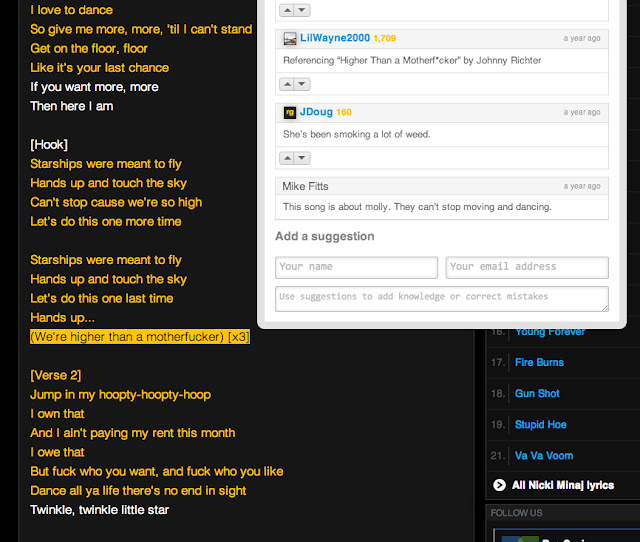
The other website I wanted to comment about works in a similar way, as a collaboration tool. It is called rapgenius: rapgenius.com. I discovered it when googling to figure out what some stuff in Nicky Minaj's song "Starships" meant.

Here's a screenshot to give you an idea:


This is very useful. In fact if anybody knows of anything like this other than for rap and hip-hop, I would love to hear about it! Most people like music and it is one of the big motivators for learning English. Singing along to your favourite singers, understanding what they mean gives you a great feeling of reward. And this is an incredible tool in that sense. It is moderated like urbandictionary, but still some noise gets through. Again, despite its shortcomings, I highly recommend it.